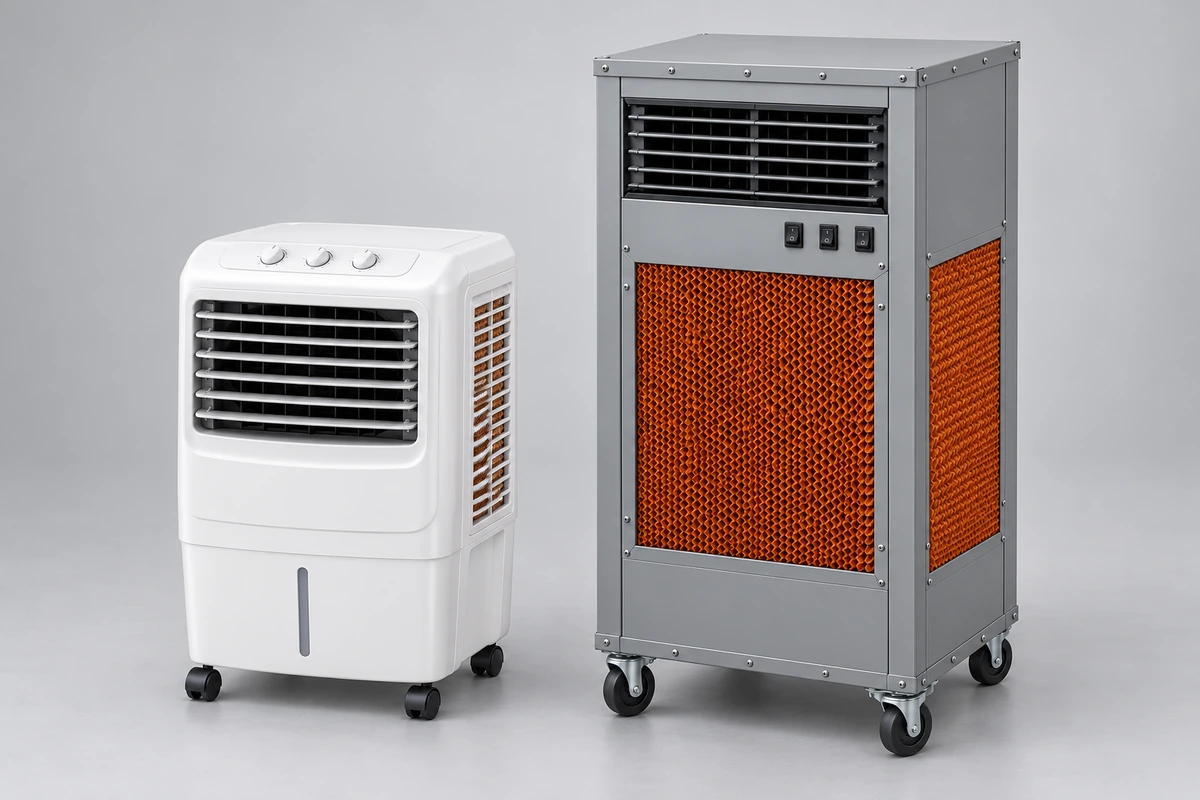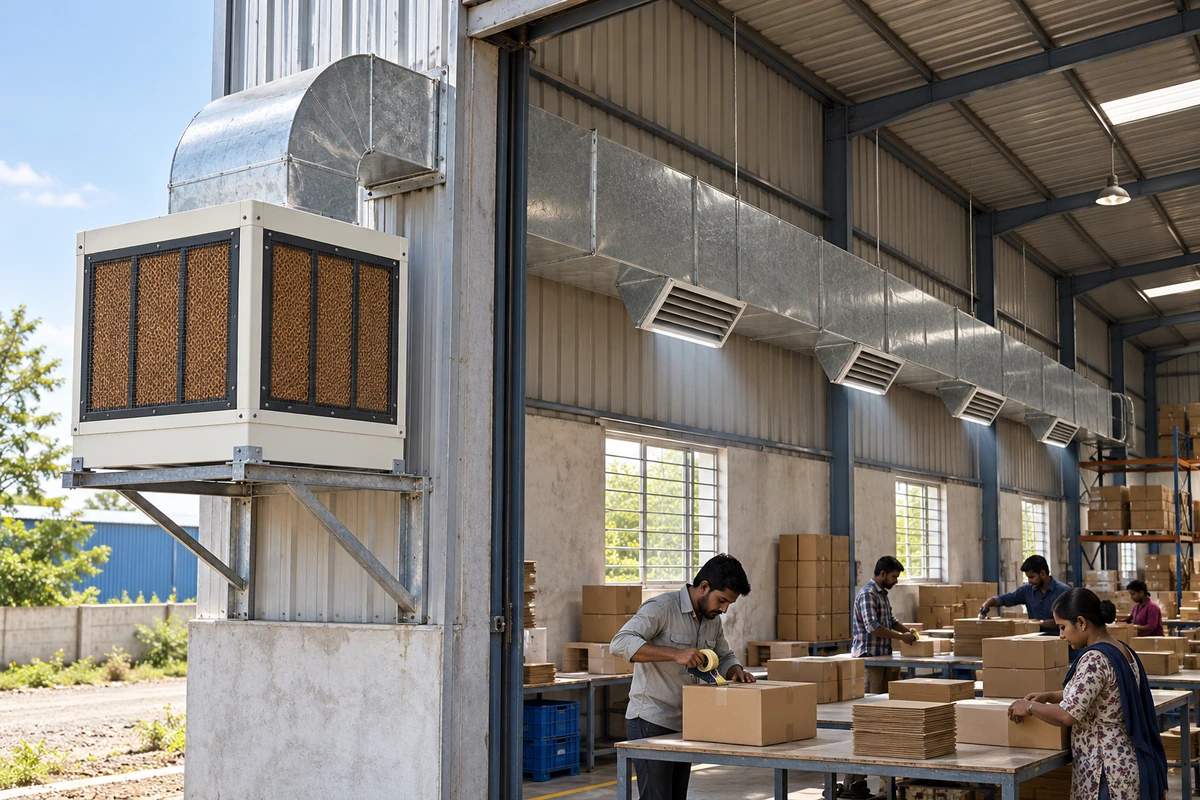
Quick answer: an air cooler cools by evaporating water, and humid air can't absorb much more water. On a dry 40°C day with 20% humidity, a good cooler can deliver air at about 26°C, a drop of nearly 14°C. On a humid 32°C day with 70% humidity, the same cooler manages only about 28°C, a drop of under 4°C, while making the room feel damp. If your space is humid for much of the year, a chilled-water cooler such as AushCool or an air conditioner is the better choice.
Why Humidity Matters
An evaporative (desert) air cooler pulls hot air through wet pads. Water evaporating from the pads takes heat from the air, so the air comes out cooler, but also moister.
There is a hard limit on how cool that air can get: the wet-bulb temperature, the lowest temperature air can reach by evaporating water into it. In dry air the wet-bulb temperature is far below the actual temperature, so there is a lot of cooling available. In humid air the two are close together, so there is very little.
A good cooler with clean, fully wet pads typically gets 70–90% of the way from the room temperature down to the wet-bulb temperature. The figures below assume 80%.
How Much Cooling to Expect
- 40°C, 20% humidity: wet-bulb about 23°C, so the cooler delivers about 26°C (about 14°C of cooling)
- 38°C, 30% humidity: wet-bulb about 24°C; cooler delivers about 27°C (about 11°C of cooling)
- 36°C, 40% humidity: wet-bulb about 25°C; cooler delivers about 27.5°C (about 8.5°C of cooling)
- 34°C, 55% humidity: wet-bulb about 27°C; cooler delivers about 28°C (about 6°C of cooling)
- 32°C, 70% humidity: wet-bulb about 27.5°C; cooler delivers about 28.5°C (about 3.5°C of cooling)
- 30°C, 80% humidity: wet-bulb about 27°C; cooler delivers about 27.5°C (about 2.5°C of cooling)
Wet-bulb temperatures calculated with Stull's (2011) formula at sea-level pressure; cooler output assumes 80% pad effectiveness. Real results also depend on airflow, ventilation and pad condition.
The pattern is clear. Air coolers work best in the hot, dry months before the monsoon, which is when most of inland Maharashtra needs cooling most. Once the monsoon arrives, or in coastal cities where the air stays humid, their cooling drops sharply.
Signs Your Air Cooler Is Fighting Humidity
- The air from the cooler feels only slightly cool, or just damp.
- The room feels sticky and clothes or paper feel damp after a few hours.
- Cooling is good in April and May but poor from June onwards.
- Cooling improves when you open more windows. That is a ventilation problem, covered below.
Getting the Most from an Air Cooler
- Ventilate. Keep a window or door open on the opposite side of the room so moist air can escape. In a closed room the cooler raises the humidity until it stops cooling, even in dry weather.
- Place it at a window or doorway so it draws in fresh outside air rather than recirculating room air that is already humid.
- Keep the pads clean and fully wet. Scale and dry patches reduce how close the cooler gets to the wet-bulb temperature.
- Size it for the room. Too little airflow can't flush out the moist air. Our air cooler size guide shows the CFM you need for each room size.
What to Use When It's Humid
AushCool does not cool by evaporating water into the room. It circulates chilled water through an FCU cooling coil, and a BLDC blower pushes room air across the coil. Because no water is added to the air, the room does not get more humid, so it keeps cooling when an evaporative cooler would not. AUSH designs AushCool to hold a room at 24–26°C. That is a design target, not a guaranteed set-point: actual results depend on room size, outdoor conditions and ventilation.
An air conditioner also removes moisture from the air as it cools. It is the most effective option in very humid weather, but it costs more to buy and run and needs the room closed up.
For many homes and shops in Maharashtra, a practical setup is an evaporative cooler for the dry summer months, with AushCool or an AC for the humid months and for rooms that can't be ventilated well.
Frequently Asked Questions
At what humidity does an air cooler stop working?
There is no single cut-off, but cooling falls steadily as humidity rises. Above about 60–70% humidity, most evaporative coolers give only a few degrees of cooling and make the room feel damp.
Does adding ice to the cooler help in humid weather?
Only a little, and only for a short time. Ice chills the water, but in humid air very little of that water evaporates, and the ice soon melts. It does not remove the humidity that is limiting the cooling.
Is an air cooler useless during the monsoon?
Not completely. On dry, hot days between rains it still helps, and its airflow alone feels better than a still room. But expect much less cooling than in April and May.
Which AUSH product should I choose for a coastal city like Mumbai?
For most of the year Mumbai's air is humid, so AushCool's chilled-water cooling is a better fit than an evaporative cooler. Contact our team with your room size and we'll recommend a model.