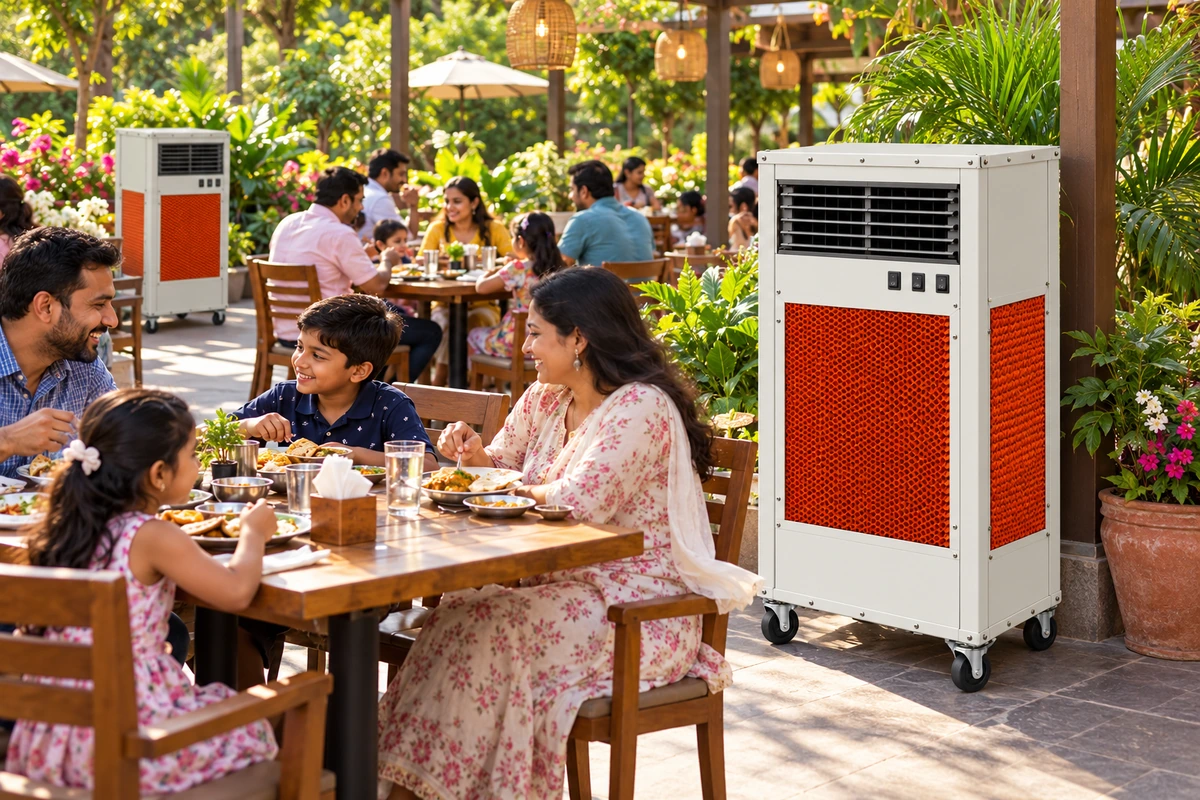
Quick answer: the best air cooler for an open garden restaurant is a high-airflow blower-type cooler that throws air a long way, placed at the edge of the seating on the upwind side and aimed at guests at seated head height. You cannot cool an open garden the way you cool a room, so cool the seating zones, not the whole space. Size each zone at about 5 CFM per sq ft of seating area. An 800 sq ft seating zone needs about 4,000 CFM: two AUSH 60 L Duct Coolers on single-phase power, or one 90 L Duct Cooler (6,500 CFM, 870 W) if you have three-phase. Plan a water line, because on hot, dry evenings an outdoor cooler can empty its tank in a few hours.
Why an Open Garden Is Different from a Dining Room
Indoors, a cooler pushes cooled air into the room and exhaust fans or windows let it out, so the whole room cools down. In a garden there are no walls. Cooled air spreads out and mixes with hot outside air within a few metres, and any breeze carries it away. That changes three things:
- Cool people, not air. Guests feel cool when moving air reaches them directly. Aim the coolers at the tables instead of trying to lower the temperature of the whole garden.
- Throw matters more than tank size. A cooler with strong airflow and a blower that builds pressure pushes air further across the seating. Tank size only decides how long the cooler runs between refills.
- Wind decides placement. A cooler blowing against the breeze loses most of its air. A cooler blowing with the breeze reaches further.
Outdoor Airflow: Getting Cool Air to the Tables
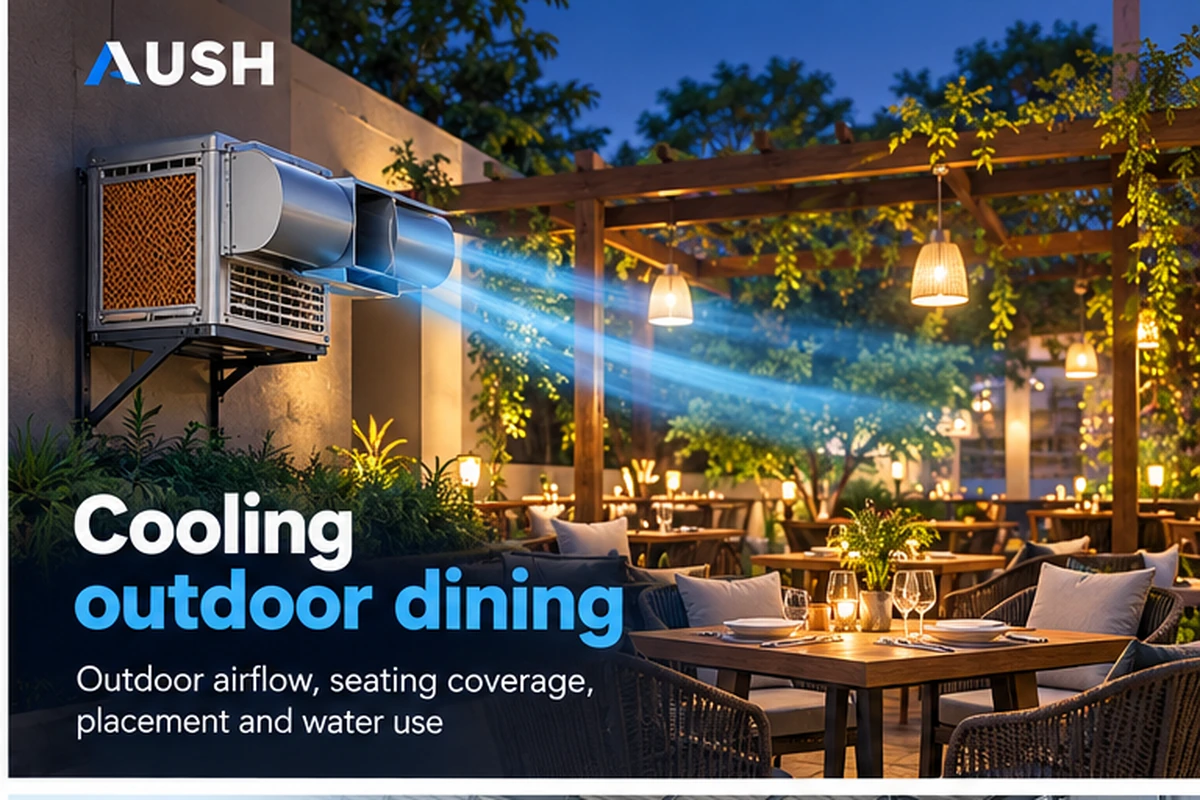
- Place coolers on the upwind side. Watch which way the evening breeze usually blows during service and put the coolers on that side, so the wind carries the cooled air across the seating.
- Aim at seated head height. A seated guest's head is about 4 ft (1.2 m) above the ground. Air blowing over their heads or into the trees does little. On a wall or pergola, mount the cooler or its grilles at about 7–8 ft and angle them down towards the tables.
- Choose a blower over an axial fan. A blower (centrifugal fan) builds more pressure than the propeller fan in an ordinary desert cooler, so it can push air through short ducts and over a longer throw. It also keeps water on the pads instead of throwing droplets into the air, which matters when guests sit close by.
- Use partial walls and shade. A bamboo screen, hedge, pergola or canopy on the windward and sunny sides holds cooled air around the tables for longer and keeps sun off guests and coolers.
- Keep the air moving one way. Two coolers blowing at each other from opposite sides cancel out. Blow from one edge across the seating, or from the edges towards the centre in a large garden, with nothing blocking the path.
Seating Coverage: How Many Coolers You Need
Measure only the area where guests sit, eat and queue, not the lawn, parking or walkways. Then size it the same way as a crowded dining room:
CFM needed = seating area (sq ft) × 5
At a typical 15–20 sq ft per guest, including tables and aisles, that works out to about 75–100 CFM per guest. Open sides waste some air, so when a result falls between two options, round up, especially on breezy sites.
| Seating zone | Airflow needed | Single-phase option | Three-phase option |
|---|---|---|---|
| 400 sq ft (about 20–25 guests) | 2,000 CFM | One 60 L Duct Cooler (2,300 CFM) | One 60 L Duct Cooler |
| 800 sq ft (about 40–50 guests) | 4,000 CFM | Two 60 L Duct Coolers (4,600 CFM) | One 90 L Duct Cooler (6,500 CFM) |
| 1,200 sq ft (about 60–80 guests) | 6,000 CFM | Three 60 L Duct Coolers (6,900 CFM) | One 90 L Duct Cooler (6,500 CFM) |
| 2,000 sq ft (about 100–130 guests) | 10,000 CFM | Five 60 L Duct Coolers (11,500 CFM) | One 120 L Duct Cooler (11,500 CFM) |
In an open garden, several smaller coolers spread around the seating often work better than one big cooler at one end, because air from a single cooler weakens before it reaches the far tables. One large three-phase cooler is cheaper to buy and to run, so it suits a long, narrow seating area it can blow straight down, or a pergola where short ducts can carry its air to several grilles. For a single small spot, such as a cash counter or a reception desk, the 450 CFM AUSH Blower Cooler (120 W) is enough.
Worked Example: 1,200 sq ft Garden Seating, 70 Guests
- Airflow needed: 1,200 × 5 = 6,000 CFM.
- Single-phase: three AUSH 60 L Industrial Duct Coolers, 6,900 CFM together, placed along the upwind edge. They cost ₹99,600 including GST and draw 2.28 kW, about ₹22.80 an hour at ₹10 per unit.
- Three-phase: one 90 L Industrial Duct Cooler, 6,500 CFM, for ₹38,500 including GST. It draws 870 W, about ₹8.70 an hour.
- Evening service: at 6 hours a night and 30 nights a month, the three 60 L coolers cost about ₹4,100 a month in electricity, and the one 90 L cooler about ₹1,570.
If the seating is spread around a lawn, the three single-phase coolers cover it more evenly. If it is one long row under a pergola, the single 90 L cooler is far cheaper to buy and run.
Cooler Placement Checklist
- At the edge, not between tables. Coolers between tables block service paths and blow too hard on the nearest guests. Keep them at the edges, about 2–3 m from the first table.
- In shade. Water in a tank in full sun warms up and cools less. An insulated tank, like the GRP tanks on AUSH Duct Coolers, helps, but shade helps more.
- Away from food and flames. Don't aim coolers at the buffet, live counters, tandoor, barbecue or candles. Moving air cools hot food, dries it out and can blow flames sideways.
- Away from the kitchen exhaust. Don't place coolers where they draw in hot, smoky kitchen air. A cooler can only cool the air it takes in.
- Secured against wind. Fix wall- or stand-mounted coolers firmly. A tall cooler on wheels can tip in a strong gust.
- Safe outdoor wiring. Use weatherproof sockets, an RCCB (earth-leakage breaker) and a proper earth for every metal-body cooler. Run cables overhead or under covers, never across walkways.
- Start early. Switch the coolers on 30–60 minutes before guests arrive, so the pads are fully wet and the seating area has cooled down.
Water Consumption: What to Plan For
An evaporative cooler cools by evaporating water, so it uses more water when it cools more: on hot, dry days. Each litre that evaporates takes about 0.7 kWh of heat out of the air. As a rough guide, on a hot, dry evening an outdoor cooler evaporates about 2 to 7 litres an hour for every 1,000 CFM, and less when the air is milder or more humid.
- 60 L Duct Cooler (2,300 CFM): roughly 5–15 litres an hour, so a full tank lasts about 4 hours or more on the hottest evenings.
- 90 L Duct Cooler (6,500 CFM): roughly 15–45 litres an hour, so a full tank can run low within 2–3 hours on the hottest evenings.
- 120 L Duct Cooler (11,500 CFM): roughly 25–80 litres an hour, so plan for a water line rather than refills.
These are estimates. To get your own figure, fill the tank before service and check the level after the first hour. Then:
- Run a water line to each cooler, so staff never have to refill with buckets during service.
- Use clean, soft water if you can. Hard water leaves scale on the pads, which blocks them and cuts cooling.
- Drain and clean weekly in season. Standing water in a tank starts to smell and can breed mosquitoes, which is the last thing a garden restaurant needs. Drain the tanks if the restaurant closes for more than a day or two.
- Choose a blower design. An AUSH blower cooler keeps water on the pads instead of throwing droplets into the air, using about 75% less water than a conventional desert cooler (see how blower coolers save water). The water that evaporates to do the cooling is still used.
Coolers vs Misting Fans for Outdoor Dining
Many garden restaurants use misting fans, which spray a fine water mist into the air. They cool well in very dry heat, but a badly tuned or clogged nozzle can leave tables, menus and guests damp, and hard water leaves white spots on furniture. A pad-type cooler cools the air inside the unit and blows out cooled air, not spray, so the seating stays dry. For dining areas, that is usually the more comfortable choice.
Evenings, Humidity and the Monsoon
Evaporative cooling works best in hot, dry air. Garden restaurants are busiest in the evenings, when the air is usually a little more humid than in the afternoon, so expect a smaller temperature drop than at midday. In the monsoon and in humid coastal cities, the drop can be small. On those days, run the coolers in fan-only mode, with the pump off, for a breeze without adding humidity. For more on this, see why air coolers stop working in humid weather. For an indoor dining hall, see how to cool a restaurant, gym or wedding hall.
Frequently Asked Questions
Which air cooler is best for an outdoor restaurant?
A high-airflow, blower-type cooler with a metal body and an insulated tank, placed at the edge of the seating on the upwind side and aimed at guests at seated head height. Size it at about 5 CFM per sq ft of seating area.
Do air coolers work in open areas?
Yes, for spot cooling. They cannot cool an open garden the way they cool a closed room, but moving cooled air aimed at the tables makes guests feel noticeably cooler, especially in hot, dry weather.
How many coolers do I need for garden seating?
Multiply the seating area in sq ft by 5 to get the CFM needed. An 800 sq ft seating zone needs about 4,000 CFM: two 2,300 CFM coolers on single-phase power, or one 6,500 CFM cooler on three-phase.
How much water does an outdoor air cooler use?
It depends on the heat and humidity. As a rough guide, about 2 to 7 litres an hour for every 1,000 CFM on a hot, dry evening, and less on milder or humid days. Large coolers should have a water line instead of manual refills.
Where should I place an air cooler in a garden restaurant?
At the edge of the seating, on the side the breeze comes from, in shade, about 2–3 m from the nearest table, and away from food counters, flames and the kitchen exhaust.