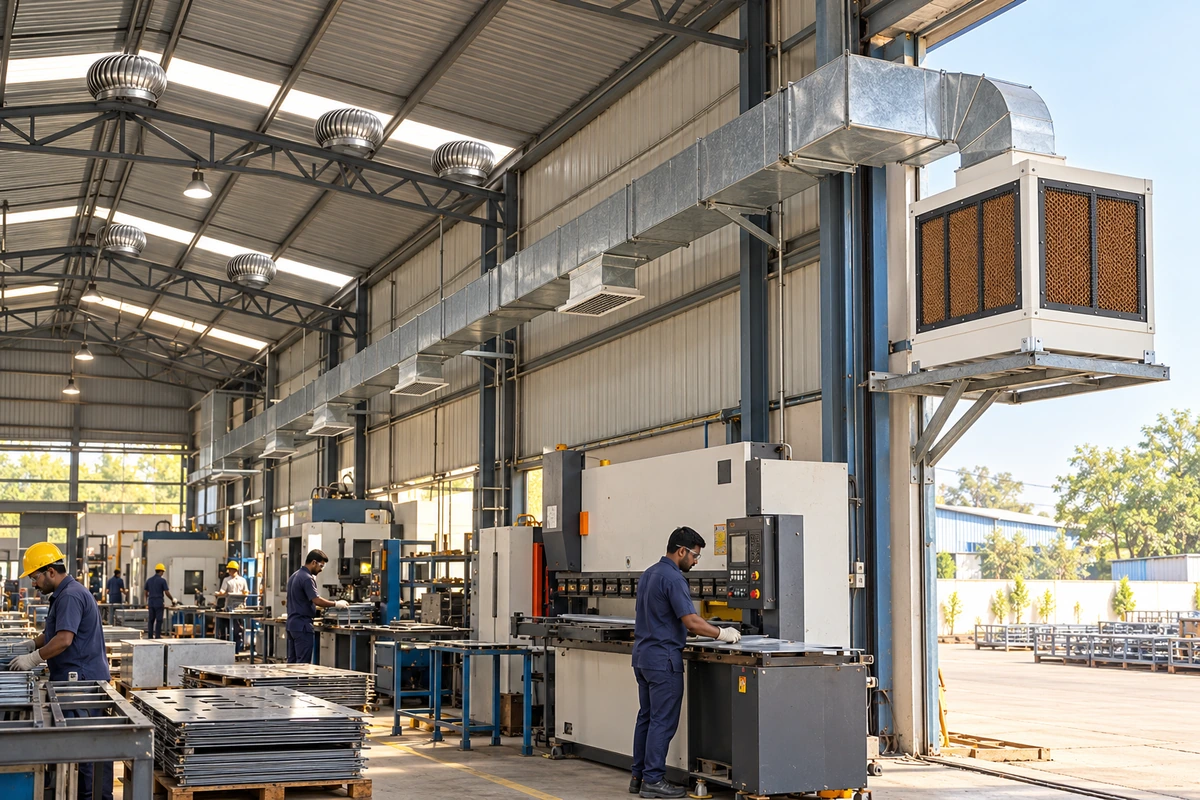
Quick answer: for a workshop or garage, choose a metal-body, blower-type cooler built for long daily running, sized at about 5 CFM per sq ft at a 10 ft ceiling (more for taller roofs). Mount it to draw fresh outside air, and keep the shutter or an exhaust fan open on the opposite side. A 300 sq ft garage needs about 1,500 CFM, which one AUSH 60 L Duct Cooler (2,300 CFM, 760 W, single phase) covers for about ₹7.60 an hour. A 600 sq ft car service garage with a 12 ft roof needs about 3,600 CFM, which one 90 L Duct Cooler (6,500 CFM, 870 W, three phase) covers for about ₹8.70 an hour.
Why Workshops and Garages Get So Hot
A workshop heats up far faster than a shop or home of the same size, because so much of its heat is made inside:
- Machines and tools: lathes, grinders, drills, compressors and welding sets turn much of the power they use into heat.
- Engines: a car or bike brought in after a ride, or run for testing, gives off heat from its engine and exhaust for a long time.
- Welding and cutting: arcs, gas torches and hot metal radiate intense heat around the work area.
- The roof: most workshops have metal sheets or asbestos-cement roofs that get far hotter than the air in direct sun and radiate heat down onto everyone below. See how to cool a factory or tin-roof shed for roof coatings, insulation and ventilators that cut this heat before it gets in.
- Closed shutters: a half-closed shutter traps hot air and fumes under the roof.
That is why we size workshops at 5 CFM per sq ft, the high-heat-load figure from our air cooler size guide, instead of the 3 CFM per sq ft used for normal rooms.
Step 1: Size the Cooler for the Heat
CFM needed = floor area (sq ft) × 5 × (roof height in ft ÷ 10)
| Space | Airflow needed | AUSH option | Supply |
|---|---|---|---|
| Tool room or site office, 150 sq ft, 10 ft, no machines | about 450 CFM | Blower Cooler 70 L (450 CFM, 120 W) | Single phase |
| Home garage or two-wheeler service, 300 sq ft, 10 ft | 1,500 CFM | One 60 L Duct Cooler (2,300 CFM, 760 W) | Single phase |
| Car service garage, 600 sq ft, 12 ft | 3,600 CFM | One 90 L Duct Cooler (6,500 CFM, 870 W), or two 60 L on single phase | Three phase |
| Fabrication workshop, 1,200 sq ft, 14 ft | 8,400 CFM | One 120 L Duct Cooler (11,500 CFM, 1.66 kW) | Three phase |
| Machine shop, 2,500 sq ft, 15 ft | 18,750 CFM | Two 120 L Duct Coolers (23,000 CFM) | Three phase |
Areas with welding, forging or heat-treatment ovens need more air than the formula gives. Instead of trying to cool the whole floor to the same level, put a grille directly over each hot workstation, so the people working there get the coolest air. A small tool room or office without machines is a normal room, so the 3 CFM per sq ft figure applies there.
Step 2: Plan Ventilation First
An evaporative cooler doesn't recirculate the workshop air. It pulls in fresh outside air, cools it through wet pads and pushes it in. That air has to leave again, or the workshop fills with warm, humid air and the cooling stops.
- Exit on the opposite side. Keep the shutter, windows, louvres or exhaust fans open on the side opposite the cooler, with enough total opening for all the air the cooler pushes in.
- Fresh air dilutes fumes, but doesn't remove them at the source. A cooler's steady supply of outside air helps clear general fumes and dust, but welding, painting and grinding still need their own fume extraction or exhaust next to the work.
- Never run engines in a closed garage. Vehicle exhaust contains carbon monoxide, which you can't see or smell. When testing engines, keep the shutter open and the exhaust piped outside, cooler or no cooler.
- Draw clean air. Place the cooler's intake away from the spray-painting area, the grinding bench and the road side where trucks idle. A cooler can only cool, and supply, the air it takes in.
Step 3: Choose Blower Airflow over an Ordinary Fan
Most cheap coolers use a propeller (axial) fan behind the pads. For a workshop, a blower (centrifugal fan) is the better choice:
- It pushes air through ducts. A blower builds enough pressure to push air through ducting to grilles over the workbenches, about 7–8 ft above the floor, instead of blowing it into the roof space from one wall.
- It throws air further. In a long garage or a shed with machines in the way, the air reaches the far end with more force.
- It keeps water off the floor. In an AUSH blower cooler, the blower sits above the pads, so loose water falls back into the tank instead of being thrown into the air. That means no wet patches on a floor that may already have oil on it, no damp electrical tools and about 75% less water use than a conventional desert cooler (see how blower coolers save water).
- Honeycomb pads cool better. Honeycomb (cellulose) pads cool more evenly and last longer than wood-wool (grass) pads, which sag and leave dry gaps.
Step 4: Make Sure It Can Run All Day
A home cooler might run a few hours a night. A workshop cooler often runs 10 hours a day, six days a week, through the whole summer. Look for:
- A metal body. It takes knocks from trolleys, ladders and parts, and doesn't soften near hot machines (see metal vs plastic coolers).
- A rust-proof, insulated tank. AUSH coolers use an insulated GRP (glass-reinforced plastic) tank, so the water never sits against metal and stays cooler in the heat.
- Three-phase power for bigger floors. The AUSH 90 L, 120 L and 150 L Duct Coolers run on 415 V three phase, which most workshops already have, and move far more air per watt. The 60 L Duct Cooler and the Blower Cooler run on a normal 220 V single-phase supply.
- A water line. Refilling by bucket during a shift is easy to forget, and a pump running on a dry tank can be damaged. Plumb a water line to the cooler, or choose the 150 L model for the longest time between refills.
- A warranty that covers commercial use. AUSH Blower and Duct Coolers carry a 2-year warranty.
Running Cost for a Workshop
At 10 hours a day, 26 working days a month and ₹10 per unit of electricity:
| Cooler | Airflow | Power | Per hour | Per month |
|---|---|---|---|---|
| Blower Cooler 70 L | 450 CFM | 120 W | ₹1.20 | about ₹310 |
| Duct Cooler 60 L | 2,300 CFM | 760 W | ₹7.60 | about ₹1,980 |
| Duct Cooler 90 L | 6,500 CFM | 870 W | ₹8.70 | about ₹2,260 |
| Duct Cooler 120 L | 11,500 CFM | 1,660 W | ₹16.60 | about ₹4,320 |
| Duct Cooler 150 L | 11,500 CFM | 2,070 W | ₹20.70 | about ₹5,380 |
Prices including GST (October 2026): Blower Cooler ₹12,083; Duct Coolers ₹33,200 (60 L), ₹38,500 (90 L), ₹43,100 (120 L) and ₹46,999 (150 L). See the duct cooler price list for details.
Worked Example: 600 sq ft Car Service Garage
- Garage: 600 sq ft, 12 ft roof, two service bays, a compressor and occasional welding.
- Airflow needed: 600 × 5 × 1.2 = 3,600 CFM.
- With three-phase power: one 90 L Duct Cooler, 6,500 CFM, for ₹38,500. It draws 0.87 kW, about ₹2,260 a month. The extra airflow helps on the hottest afternoons and over the welding corner.
- With single-phase power only: two 60 L Duct Coolers, 4,600 CFM together, for ₹66,400. They draw 1.52 kW, about ₹3,950 a month.
Mount the cooler on the back or side wall, away from the road, and run a short duct with grilles over the two bays. Keep the front shutter open as the exit.
Placement and Safety Tips
- Outside, in shade: mount the cooler on the outside wall or a stand so it draws outdoor air, with a canopy or shade if possible.
- Away from sparks: keep coolers and grilles away from welding and grinding sparks, and keep water away from welding sets.
- Good earthing: plug metal-body coolers into a properly earthed supply with an RCCB (earth-leakage breaker), and keep cables off a floor that may have oil or coolant on it.
- Clean the pads often: workshop dust and grinding grit clog pads faster than in a home. Rinse the pads and clean the tank every week or two in season. Hard water leaves scale that blocks the pads and cuts cooling.
Humidity, Rust and When to Choose Something Else
An evaporative cooler adds moisture to the air. With a good exit, the humid air leaves as fast as it comes in. But if it lingers, bare steel parts, machined surfaces and hand tools can rust faster. Keep the exit open, oil or cover finished parts, and on humid monsoon days run the cooler in fan-only mode, with the pump off, for ventilation without extra moisture. See why air coolers stop working in humid weather.
A cooler cools people, not machines. If a moulding machine, CNC spindle, laser or hydraulic system needs a fixed temperature, it needs an industrial chiller on the machine. A small enclosed electronics room or office that must stay closed is better served by air conditioning.
Frequently Asked Questions
Which air cooler is best for a workshop?
A metal-body, blower-type cooler with an insulated, rust-proof tank, rated for long daily running, sized at about 5 CFM per sq ft at a 10 ft roof. For most workshops, that means an industrial duct cooler rather than a home cooler.
How many CFM do I need for a garage?
Multiply the floor area by 5, then by the roof height in feet divided by 10. A 300 sq ft garage with a 10 ft roof needs about 1,500 CFM; a 600 sq ft garage with a 12 ft roof needs about 3,600 CFM.
Can an air cooler run all day in a workshop?
Yes, if it is built for it. Choose a metal body, an insulated GRP tank and a water line so the tank never runs dry, and clean the pads regularly because workshop dust clogs them.
Will an air cooler make my tools rust?
Not if the workshop has a good exit for the air. Rust becomes a risk when humid air lingers in a closed space. Keep the shutter or exhaust open, oil finished parts, and switch to fan-only mode on humid days.
Is an air cooler or an AC better for a garage?
For a garage or workshop with the shutter open, an air cooler. It costs a fraction of an AC to buy and run and works with the doors open. An AC only suits a closed, insulated room such as an office.
Do I need three-phase power for a workshop cooler?
Only for the larger AUSH Duct Coolers: the 90 L, 120 L and 150 L models need 415 V three phase. The 60 L Duct Cooler and the Blower Cooler run on a normal 220 V single-phase supply.