Quick answer: a low water consumption air cooler should cut wasted water, not the water that evaporates, because evaporation is what does the cooling. A cooler that evaporates less simply cools less. So look for a design that keeps every drop on the pads: a blower mounted above the pads instead of a fan right behind them, honeycomb pads that wet evenly, airflow matched to your room, an insulated tank and a fan-only mode. In AUSH's measurements, the AUSH Blower Cooler uses about 75% less water than a conventional desert cooler for the same cooling, because its design stops the spray that desert coolers throw into the room.
Why High Cooling and Low Water Seem to Clash
An evaporative cooler cools air by evaporating water into it. Every litre that evaporates takes about 0.68 kWh of heat out of the air, roughly what a 1.5-ton AC removes in 8 minutes. That means the water that evaporates is not waste. It is the cooling.
The water you can save is everything else that leaves the tank without evaporating on the pads:
- Carry-over: droplets torn off the wet pads by the fan and thrown into the room as spray. In a conventional desert cooler, this is the biggest loss.
- Overflow and uneven wetting: water streaming down one side of a clogged or sagging pad and back into the tank, or splashing out.
- Running the pump for nothing: a pump left on with the fan off, or on humid days when little water can evaporate.
- Leaks: cracked tanks, loose pipes and worn float valves.
So the best cooler is not the one with the smallest litres-per-hour figure. It is the one that turns the largest share of its water into cooling.
What Makes a Cooler Cool More
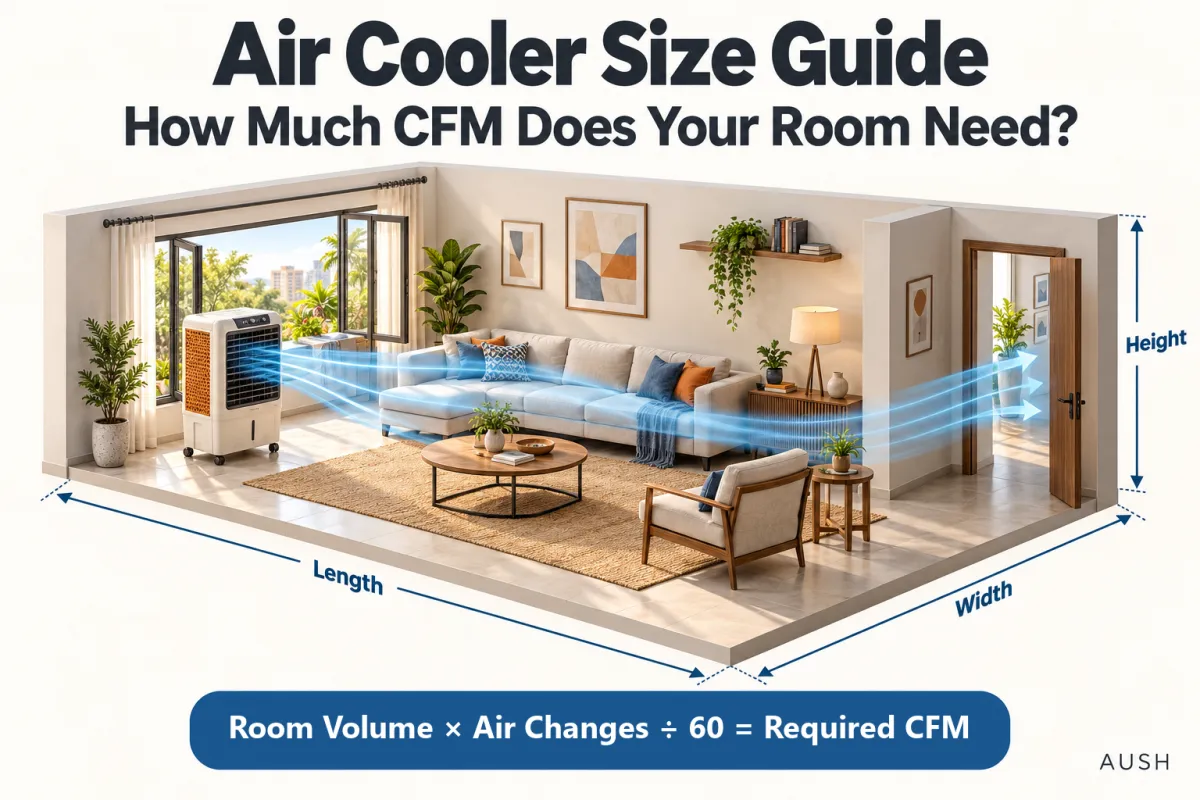
- Enough airflow for the room. Plan about 3 CFM per sq ft for a normal room with a 10 ft ceiling, and 5 CFM per sq ft for kitchens, shops and crowded rooms (see our air cooler size guide). An undersized cooler can't keep up however good its pads are.
- Good pads, evenly wet. The longer air stays in contact with wet pad surface, the closer it gets to the lowest temperature evaporation can reach, the wet-bulb temperature. Honeycomb (cellulose) pads have angled channels that spread water evenly and give a large wet surface. Wood-wool (grass) pads sag over a season and leave dry gaps that let hot air through.
- Fresh, dry incoming air. Place the cooler at an open window or door so it pulls in outside air, and keep an exit open on the far side. A cooler recirculating damp room air cools less every minute.
- Cool water. An insulated tank in the shade keeps the water from heating up in the sun.
Humidity matters more than any feature. On a dry 40°C day, a good evaporative cooler can bring the air down to the mid-20s °C. On a humid day, it cools far less. See why air coolers stop working in humid weather.
Buying Checklist: High Cooling, Low Water
| Check | Why it helps cooling | Why it saves water |
|---|---|---|
| Blower above the pads, not a fan right behind them | Draws air evenly through the whole pad | Droplets fall back into the tank instead of being thrown into the room |
| Honeycomb (cellulose) pads | Large, evenly wet surface brings air closer to wet-bulb | Holds water on the pad instead of letting it stream off |
| CFM matched to the room | Replaces hot air fast enough | No oversized cooler evaporating water into an already cool room |
| Insulated, rust-proof tank | Water stays cooler in the sun | No rust holes or leaks over the years |
| Fan-only mode and separate pump switch | Breeze on humid days without sticky air | Pump off when evaporation is weak |
| No spray at the grille | Dry, comfortable air | Spray is water that was never used for cooling |
How to Compare Coolers in a Shop
Water-use figures on boxes are hard to compare, because they depend on the weather and the test. These checks work on any cooler:
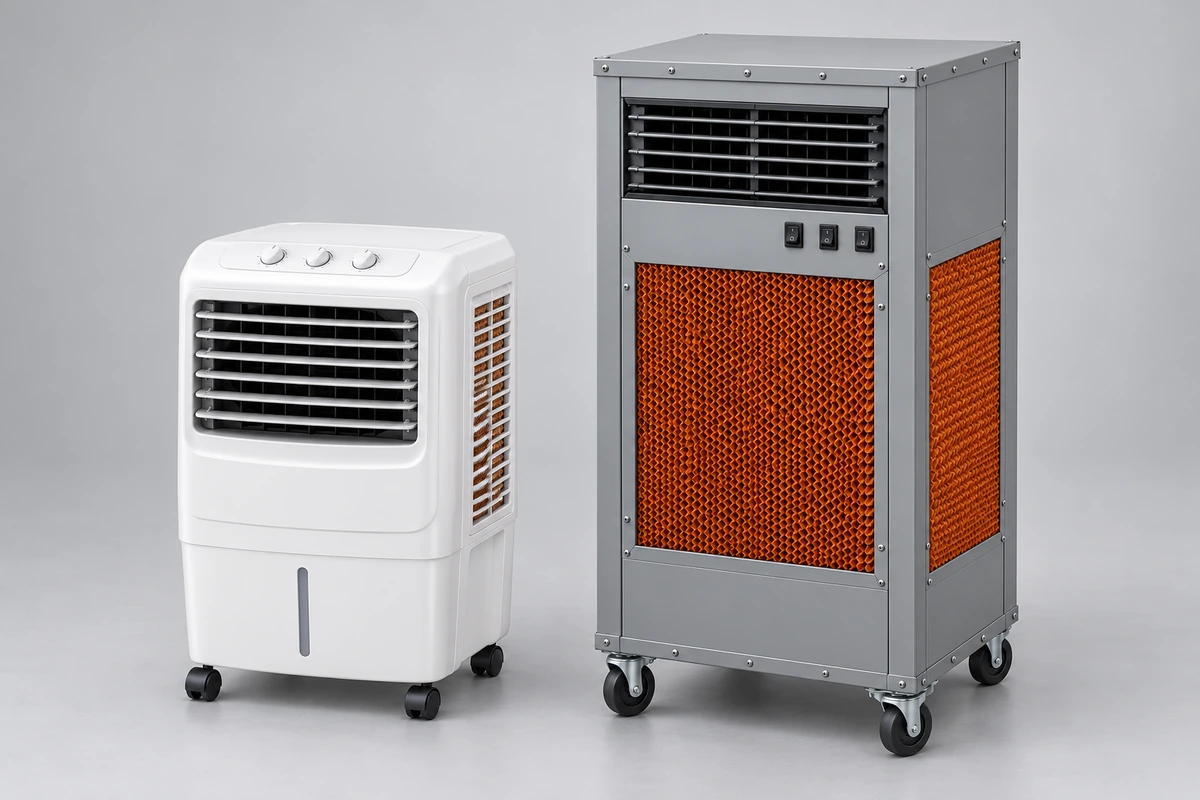
- Look at where the fan sits. If a large propeller fan sits directly behind the pads, expect carry-over. A blower mounted above the pads avoids it.
- Hold a dry tissue at the grille on a running demo unit for a minute. Damp spots mean the cooler is throwing water.
- Check the floor in front of the cooler. Wet tiles near a cooler that has been running a while are a sign of carry-over.
- Ask for the CFM, not just the tank size. Tank size only decides how long the cooler runs between refills, not how much it cools.
- Check the pads and the tank. Honeycomb pads and an insulated, rust-proof tank cool better and last longer.
At home, measure for yourself: fill the tank to a mark, run the cooler for an hour, and see how much water it took. Then check for wet patches around it. Low water use with dry surroundings and cool air is what you want. Low water use with warm air just means the pads are dry.
The AUSH Blower Cooler Design
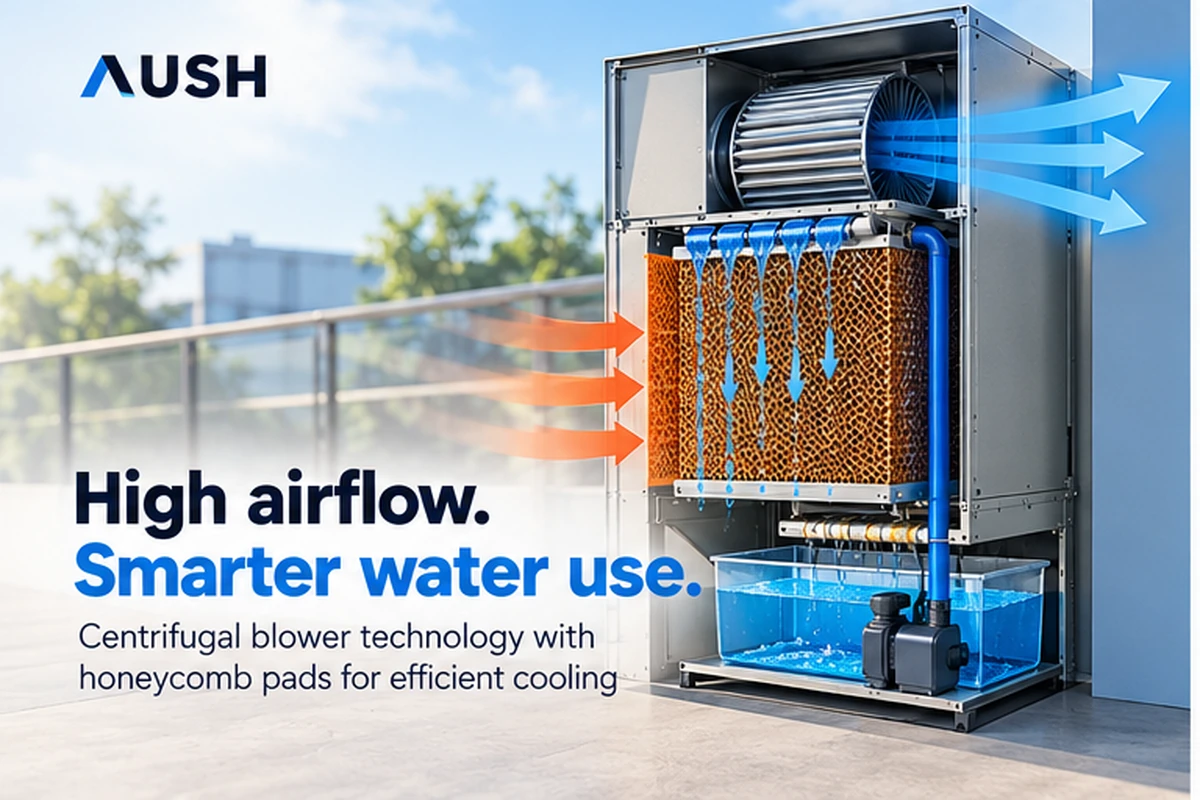
- Blower above the pads. In the AUSH Blower Cooler, air is drawn through the honeycomb pads and then turns upward into a blower mounted above them. Water droplets are much heavier than air, so they can't make that turn. They fall back into the tank and stay available for cooling. The full explanation, with a diagram, is in how a blower cooler saves 75% water.
- Honeycomb pads that wet evenly across their whole surface.
- Insulated GRP tank (glass-reinforced plastic), so the water stays cooler and never sits against metal.
- Metal body that handles sun, knocks and long hours.
Measured Water-Saving Performance
In AUSH's measurements, the AUSH Blower Cooler uses about 75% less water than a conventional desert cooler doing the same cooling job. The water it saves is the spray a desert cooler throws off its pads. The water that evaporates on the pads, which does the cooling, is still used, so the cooling doesn't drop.
- Per day: if a desert cooler uses 100 litres for a day's cooling, the AUSH Blower Cooler uses about 25 litres for the same cooling.
- Per summer: over 120 days, that is about 9,000 litres saved per cooler, and about 36,000 litres for a shop or office running four coolers.
- Fewer refills: by our estimate, a 450 CFM cooler evaporates roughly 1–3 litres an hour on a hot, dry day, so the 70 L tank can run most of a day between refills.
- Dry surroundings: no spray means no wet floor, damp furniture or wet stock in front of the cooler.
Your actual water use depends on the weather, the room and the hours you run the cooler. Hotter, drier days evaporate more. The share saved stays about the same.
Which AUSH Cooler to Choose
- Bedroom, cabin or small office, up to about 150 sq ft: the AUSH Blower Cooler 70 L, 450 CFM, 120 W, 220 V single phase, ₹12,083 including GST (October 2026), with a 2-year warranty.
- Shop, hall or workshop up to about 800 sq ft: the 60 L Industrial Duct Cooler, 2,300 CFM, 760 W, single phase, ₹33,200.
- Larger floors: the 90 L (6,500 CFM), 120 L and 150 L (11,500 CFM) Industrial Duct Coolers on three-phase power. They use the same blower-above-the-pads principle and the same 75% water saving. See the duct cooler price list.
Get the Most Cooling From Every Litre
- Size it right. Match CFM to the room using the size guide.
- Pull in outside air. Put the cooler at an open window or door and keep an exit open on the opposite side.
- Switch the pump off on humid days. Use fan-only mode when the air is already damp; the water would do little.
- Keep the pads clean. Rinse them every few weeks in season. Hard water leaves scale that blocks the channels and makes water stream off one side.
- Drain and refill weekly. Fresh water stops smells. The drained water can go to plants if nothing has been added to the tank.
For more ways to boost cooling, see how to make your air cooler cool more.
Frequently Asked Questions
Which air cooler uses the least water?
One that wastes the least, which usually means a blower cooler with the blower above the pads, honeycomb pads and an insulated tank. In AUSH's measurements, the AUSH Blower Cooler uses about 75% less water than a conventional desert cooler for the same cooling.
Does low water consumption mean less cooling?
Not if the saving comes from cutting waste. The water that evaporates on the pads does the cooling and is still used. The saving comes from spray, overflow and leaks, which do almost nothing for cooling. A cooler that saves water by keeping its pads dry will cool less.
How much water does an air cooler use per hour?
It depends on the heat, humidity and airflow. As a rough estimate, on a hot, dry day a cooler evaporates about 2 to 7 litres an hour for every 1,000 CFM, so a 450 CFM cooler uses roughly 1–3 litres an hour. A desert cooler that throws spray uses more on top of that.
Is a blower cooler better than a desert cooler?
For water use and a dry room, yes. A blower above the pads lets droplets fall back into the tank instead of spraying them into the room, and draws air evenly through the whole pad. Choose the size by CFM for your room.
How can I tell if my cooler is wasting water?
Look for wet floors or furniture in front of it, damp spots on a tissue held at the grille, or water streaming down one side of the pads. Each of these is water leaving the tank without cooling the air.