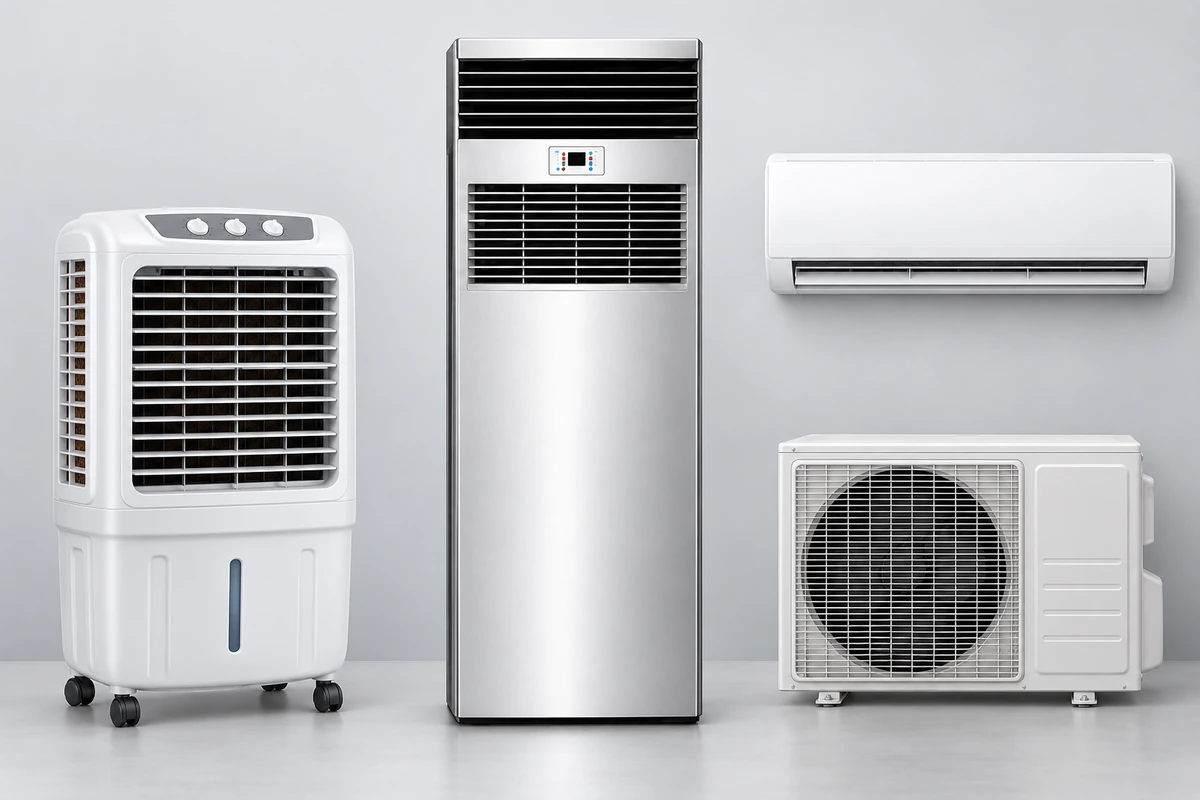
Quick answer: choose an air cooler for homes, shops and factories in dry weather. It is the cheapest to buy and run, but it needs open windows and weakens when it is humid. Choose a hybrid conditioner for closed rooms that must stay comfortable in humid weather too. Choose an air conditioner for sealed rooms where you want the lowest temperature in any weather, at the highest running cost. Choose a chiller when a machine or process needs cold water, not cold air, such as injection moulding, CNC, food or pharma lines.
The Four Technologies at a Glance
| Air cooler | Hybrid conditioner | Air conditioner | Chiller | |
|---|---|---|---|---|
| How it cools | Evaporates water from wet pads | Chilled water through a cooling coil | Refrigerant through a cooling coil | Chills water for a machine, process or coil |
| Best for | Dry-weather homes, shops, factories, open spaces | Closed rooms, in humid or dry weather | Sealed rooms, any weather | Moulding, CNC, food, pharma, plating |
| Humid weather | Weak | Works | Works, and removes humidity | Not affected |
| Room | Needs open windows | Works with the room closed | Must be closed | Not used for room air directly |
| Adds humidity | Yes | No | No, removes it | No |
| Typical result | Dry 40°C day down to about 26°C | Holds about 24–26°C (design target) | Usually set to 22–26°C | Water at a set temperature |
| Running cost, 800 sq ft* | About ₹7.50/hour (one 750 W cooler) | Ask AUSH for your room | About ₹30–45/hour (three 1.5-ton ACs) | Sized in TR to the heat load |
| AUSH range | Blower Coolers ₹8,500–₹14,200; Duct Coolers ₹33,200–₹46,999 | AushCool AC-80 ₹16,999, AC-100 ₹19,999; Hybrid Conditioner 1.5 Ton ₹31,999 | Not sold by AUSH | Industrial chillers from ₹33,500; Domestic Chillers ₹13,300–₹15,200 |
*10 hours a day at ₹10 per unit. Prices include GST, October 2026.
Air Cooler (Evaporative)
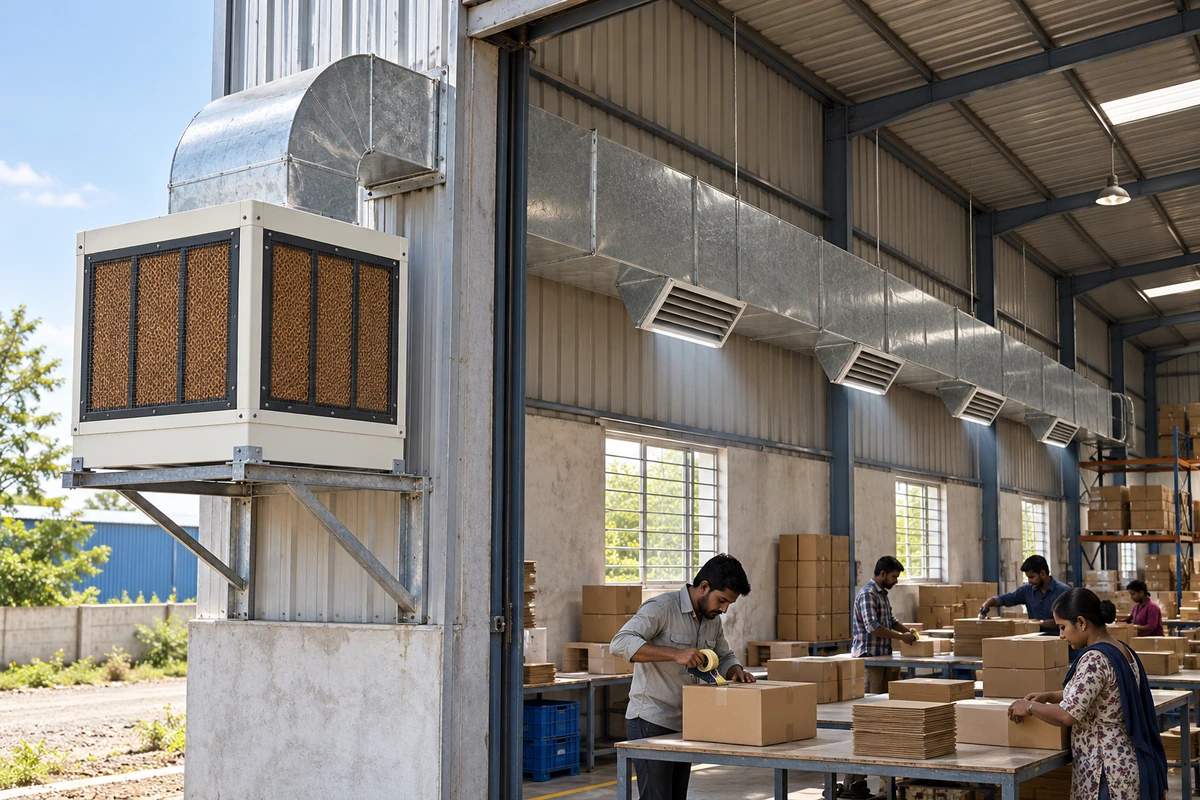
An air cooler blows outside air through wet pads. As the water evaporates, it takes heat out of the air. On a dry 40°C day at 20% humidity, a good cooler brings the air down to about 26°C, for a fraction of an AC's running cost.
- Strengths: lowest purchase and running cost, fresh outside air, works with doors and windows open, scales from one room to a whole factory.
- Limits: cooling falls sharply as humidity rises, it adds moisture to the room, and it needs an exit for the air. See why air coolers stop working in humid weather.
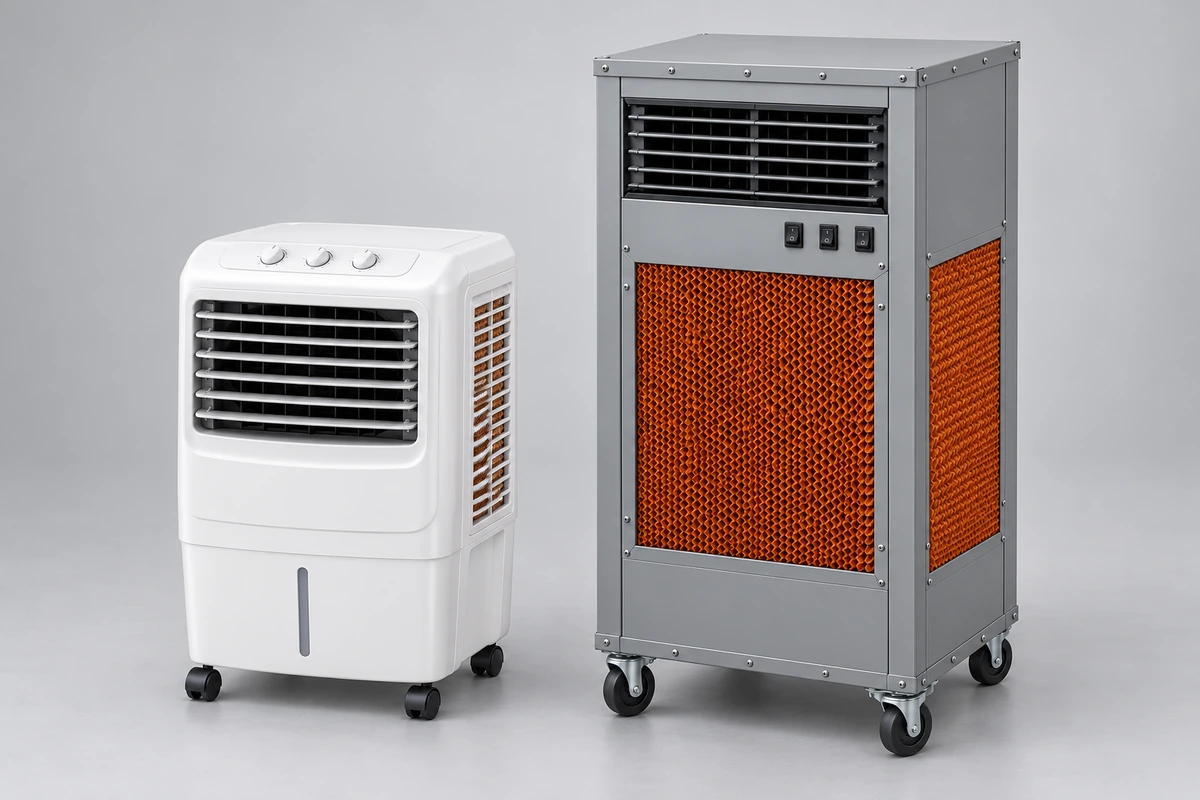
- Types: desert coolers, blower coolers and ducted industrial coolers. A blower cooler uses about 75% less water than a desert cooler (see how blower coolers save water).
Hybrid Conditioner (Chilled Water + Coil)
A hybrid conditioner such as AushCool circulates chilled water through an FCU cooling coil, and a BLDC blower pushes room air across the coil. No water is added to the air, so the room does not get humid, and it keeps cooling when an evaporative cooler would not. AUSH designs AushCool to hold a room at about 24–26°C. That is a design target, not a guaranteed set point, since results depend on room size, outdoor conditions and ventilation.
- Strengths: works in humid weather and with the room closed, adds no moisture, runs on a normal single-phase socket.
- Limits: made for rooms, not open sheds; it does not reach the low set temperatures an AC can.
- Best for: bedrooms, offices and clinics, especially in humid cities such as Mumbai, or during the monsoon anywhere.
Air Conditioner
An air conditioner pumps heat out of a sealed room using a refrigerant, and removes moisture as it cools. It reaches the lowest temperatures and works in any weather, but it costs the most to buy and run. As a rule of thumb, it needs about 1 ton of capacity for every 125–200 sq ft in Indian summers.
- Strengths: any weather, lowest temperatures, dehumidifies.
- Limits: needs a closed room; highest running cost (see air cooler vs AC running cost); impractical for open shops, sheds and halls.
Chiller
A chiller does not cool a room by itself. It produces cold water, or a water-glycol mix, at a set temperature and pumps it to wherever the cooling is needed. Chiller capacity is measured in tons of refrigeration (TR); 1 TR is about 3.5 kW of cooling.
- Industrial process cooling: injection moulding and plastics, food and beverage processing, pharmaceutical manufacturing, electroplating, and laser or CNC machines. AUSH's air-cooled range runs from 1/4 TR to 60 TR, and the water-cooled line goes up to 200 TR. The IC-1.5T (1.5 TR) costs ₹33,500.
- Cold water for cooler pads: a small AUSH Domestic Chiller supplies 20°C water to a desert cooler's honeycomb pads, adding cooling on top of evaporation (see how to make your air cooler cool more).
- Central cooling: in large buildings, a chiller feeds cooling coils in air-handling units. This is the same chilled-water principle a hybrid conditioner uses at room scale.
Which One Should You Choose?
- Home in inland Maharashtra (Nashik, Pune, Jalgaon, Sambhajinagar) for the dry summer months: an air cooler. Add a hybrid conditioner for the bedroom if you also want comfort through the monsoon.
- Home or office in a humid coastal city like Mumbai: a hybrid conditioner or an AC.
- Bedroom you keep closed at night: a hybrid conditioner or an AC, not an evaporative cooler.
- Shop with an open front, showroom or clinic waiting area: a metal-body blower cooler, or a duct cooler for bigger floors.
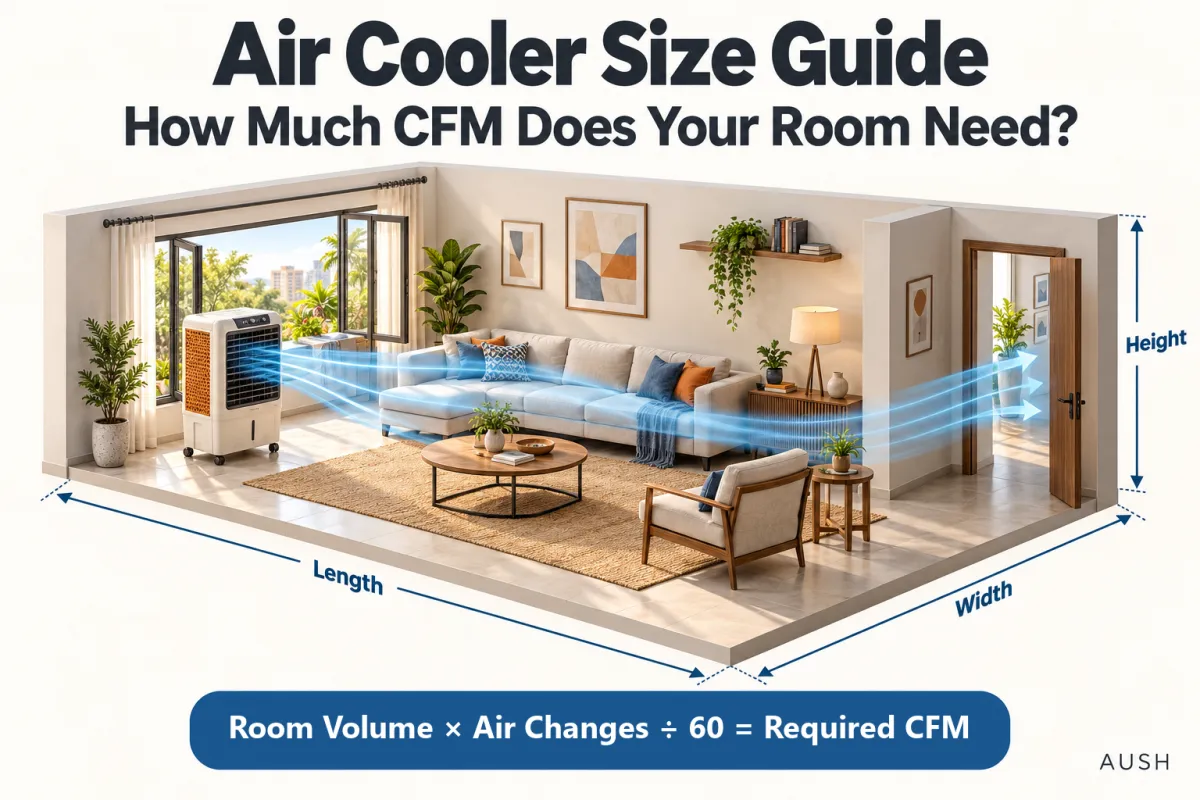
- Restaurant, gym, banquet hall or marquee: duct coolers sized at about 5 CFM per sq ft (see cooling a restaurant, gym or wedding hall).
- Factory, workshop or godown with a tin roof: industrial duct coolers plus roof heat control (see how to cool a factory or tin-roof shed).
- Moulding machine, CNC spindle, laser, plating bath or food line: an industrial chiller, sized in TR to the process heat load.
Cost Comparison for an 800 sq ft Shop
- Air cooler: one AUSH Blower Cooler (2,300 CFM, 750 W) from ₹8,500. It costs about ₹7.50 an hour, or ₹2,250 a month at 10 hours a day.
- Air conditioner: about three 1.5-ton ACs. They cost about ₹30–45 an hour, or ₹9,000–₹13,500 a month on the same basis.
- Hybrid conditioner: made for closed rooms rather than an open shop floor. Ask us to size one for a cabin or back office.
Frequently Asked Questions
What is the difference between an air cooler and a hybrid conditioner?
An air cooler cools by evaporating water into the air, so it needs dry weather and open windows and adds humidity. A hybrid conditioner passes room air over a coil filled with chilled water, so it adds no humidity, works with the room closed and keeps cooling in humid weather.
Which is cheapest to run: cooler, hybrid conditioner or AC?
An air cooler is by far the cheapest. A 750 W blower cooler covering 800 sq ft costs about ₹7.50 an hour at ₹10 per unit, while the three 1.5-ton ACs the same space needs cost about ₹30–45 an hour.
Can a chiller cool a room?
Not on its own. A chiller makes cold water, which then cools a room through a coil and fan, as in a hybrid conditioner or an air-handling unit, or through a cooler's pads. Industrial chillers are mainly used to cool machines and processes.
What works best in humid weather?
A hybrid conditioner or an air conditioner. Evaporative coolers lose most of their cooling when the air is already humid, as in coastal cities and during the monsoon.
What is the best cooling solution for a factory?
For the shop floor, industrial duct coolers with good roof insulation and exhaust, which cost a fraction of AC. For machines and processes that need a fixed temperature, an industrial chiller.
Is a hybrid AC the same as an air conditioner?
No. An air conditioner uses refrigerant in the indoor coil and reaches lower temperatures. AUSH's hybrid conditioner circulates chilled water through the coil and is designed to hold a room at about 24–26°C.